Sunday, February 12, 2006

Nothin' Says Lovin' Like Somethin' from the Oven

JPII explains:

The proper end of the sexual urge is the existence of the species Homo, its continuation (procretio), and love between persons, between man and woman, is shaped, channeled one might say, by that purpose and formed from the material it provides. It can therefore take its correct shape only in so far as it develops in close harmony with the proper purpose of the sexual urge. An outright conflict with that purpose will also perturb and undermine love between persons. (52-3)

Wow! JPII is particularly referring to contraceptive acts here. A husband and wife must recognize the life-giving purpose behind the use of the sexual urge, and they must never do anything to thwart that purpose (i.e. sterilization, coitus interruptus, or use of barriers or chemical contraceptives of any kind). JPII says that "man often accords the sexual urge a merely biological significance and does not fully realize its true, existential significance - its link with existence" (53). When we think of something as merely biological, we tend to think it is okay to manipulate and alter it. Recognizing the "natural purpose of the sexual urge" as pro-creative and existential does not banish love from the equation. JPII says rather that recognizing the procreative purpose of the sexual urge gives conjugal love its true character (53).

In taking marital vows a man and a woman should be consciously choosing to "participate in the whole natural order of existence," being completely open to facilitating "the existence of another concrete person, their own child, blood of their blood, and flesh of their flesh" (53). As JPII says, "This person is at once an affirmation and a continuation of their own love. The natural order of human existence is not in conflict with love between persons but in strict harmony with it" (53).

Love between a man and woman is intimately connected with the utilization of the sexual urge. JPII explains that whenever a couple seeks to circumvent the purpose of the sexual urge by artificial means they are actually damaging the love between them.

There are of course times in which the sexual act simply cannot bring about the conception of a new human person (i.e. when a woman is not fertile - which is the majority of the time). Also, when a woman is already pregnant, if either of the spouses are sterile, or if a woman is post-menopausal, then conception is not biologically possible. JPII tells us that another value of the sexual urge, apart from its procreative purpose, is to bring together men and women into reciprocal and complementary relationships.

He elaborates:

If the spouses are to take legitimate advantage of the energy which the urge releases, and of its natural promptings, they must before all else take into account its basic meaning and rationale. If this condition (that nothing shall be done to negate the proper purpose of the urge) is fulfilled, then even when a new human being cannot be born from the union of a man and woman, or from a particular occasion of sexual intercourse, the spouses are none the less reborn in love, and so to speak give birth to each other in their interpersonal communion. (f.n. 17, p294)

I am reminded of a passage from C.S. Lewis's Mere Christianity. I do not have the book, so I cannot quote it directly, but he speaks of the natural law and of morality regarding contracepted use of the sexual urge. He compares the use of the sexual urge to the use of the urge to eat. The primary purpose for hunger and the desire to eat is that we will indeed eat and be nourished and continue to live. (Remember, existence is our first and primary good :-)

However, there is pleasure attached to eating (unless of course the food tastes bad, is poisonous, or if you simply have no sense of taste or smell). This is comparable to the fact that pleasure is often attached to the use of the sexual urge, but pleasure is not guaranteed and is not a purpose of the sexual urge. By the way, Janet E. Smith in her talk "Contraception: Why Not?" makes the point that God attaches pleasure to those things which He wants us to do for our own continuation and health. Such things include sex, eating, sleeping, and exercising. I think that's fascinating.

Lewis compares contracepted intercourse to bulimia. The bulimic wants the pleasure of eating, but because he does not want to follow the act through to its natural end and experience its natural consequences, he forces himself to throw-up after he experiences enough of the pleasure of beginning the eating process. Likewise, contraception is an unnatural act by which a couple seeks to enjoy some of the pleasure of the sexual act without following it through to its natural end and experiencing its natural consequences. The consequence that most couples are trying to avoid when contracepting is the conception of a child. (The couple does not realize that there is much pleasure also to be had in the begetting of and rearing of their own children.)

Some couples have grave reasons for seeking to avoid pregnancy, particularly if the mother has a condition in which a pregnancy can cause her to die. The Church holds forth any number of modern, scientific Natural Family Planning methods for use in situations like these. (We are not talking "rhythm method" okay?)

Natural Family Planning (NFP) involves the charting of the wife's fertility-cycle. During the wife's "fertile window" the spouses mutually abstinence from intercourse (including any other act which would cause one of the spouses to come to sexual climax apart from the act of intercourse; that's a whole 'nother element of Catholic sexual moral teaching). The difference between NFP and contraceptive acts is that NFP refuses to utilize the sexual urge for the sole purpose of pleasure while intentionally thwarting the procreative capability of that act.

NFP also has some benefits in that it fosters communication between the spouses, prayer, a greater understanding of the woman's body and health, and also the virtues of self-control and self-discipline. During the woman's fertile period, the couple must seek creative, non-sexual ways to express their love. NFP can also help a couple to know when to "try for" a baby because they are aware of their fertile periods. It is still possible for a couple of use NFP with a "contraceptive mentality", but I do think the practice as a whole has a positive influence on the couple's openness to life and selflessness with one another.

Thursday, February 9, 2006

The Existential Significance of the Sexual Urge

What is the foundational purpose of the sexual urge? Come on, take a guess!!!

It's pro-creation, the continuation of the species.

"What?!" some might exclaim. "It's not love? It's not pleasure? Is the purpose of sex to have as many babies as humanly possible?! What happened to the 'personalistic norm' here? Isn't that another form of utilitarianism? Ahhhhhh!!!"

Yes, that could definitely be a utilitarian approach of a different variety. Love does has something to do with the sexual urge; JPII very much affirms that the sexual urge provides the "material for love between persons, between man and woman" (51). However, he also points out that two persons of the opposite sex can have much love for one another and yet have no sexual chemistry or attraction for one another. Love is also not guaranteed between two people who have sex. Love is dependent on human free will. Therefore we can deduce that the primary purpose of the sexual urge is the continuation of the human species. But, as we will see in my next blog entry, JPII will also address those more personalistic, incidental purposes of the sexual urge.

JPII writes:

The existence of the whole species Homo depends directly on [the sexual urge]. The species could not exist if it were not for the sexual urge and its natural results. . . . Human kind can be maintained in being only so long as individual people, individual men and women, human couples, obey the sexual urge. (51)

If the sexual urge had not been built into our nature, we human beings just might cease to exist. Seriously.

JPII points out that "existence is the first and basic good for every creature. . . . All other goods derive from this basic good" (51).

He continues:

Man's multifarious works, the creations of his genius, the fruits of his holiness are only possible if the man - the genius, the saint - comes into existence. To be he had to begin to exist. The natural route by which human beings begin to exist passes through the sexual urge. (52)

Although the sexual urge is a force of nature, we do not study it merely from a biological standpoint. The sexual urge has more than a biological significance; it has an existential significance. The sexual urge is intimately bound to the very existence of mankind in general. The study of existence itself is a subject of philosophy. Natural sciences (such as biology and chemistry) are not directly concerned with existence in and of itself; rather these fields take "existence for granted as a concrete fact inherent in the object which it studies" (52). Because of the existential significance of the sexual urge, it is imperative to consult philosophy in determining the "true importance of the sexual urge, which has obvious implications in the realm of sexual morality" (52).

Remember the Catholic assertion that human existence is "that first and most basic good"(52)? If the sexual urge is intimately connected to the existence of the human person, then the sexual urge is not meant to be used for just any end a man may choose. Although "it is there for man to use,” the sexual urge must follow principles regarding respect for the human person, and the sexual urge must not be utilized in absence of "love for the person" nor used in contradiction to “love for the person” (52).

It is interesting to think, as JPII points out, that the sexual urge is wired into every man by God's design. It was His idea, not ours! And furthermore, God gave us predetermined purposes for the sexual urge that remain independent of any man’s will. So, we don't make the rules about the sexual urge and its purposes, and when we try to we do so to our own peril. For, as a professor of mine once said, "Reality can only bear the weight of a bad idea for so long." (He may have been quoting a book called Ideas Have Consequences by Richard Weaver. I’m not sure.)

We must cooperate with the reality of things in life. We are not doing ourselves any favors by going against the grain of the built-in meaning and purpose of the sexual urge. I particularly like the way Rick Santorum deals with this topic of cooperating with the "natural law" in his book It Takes a Family.

Santorum explains in chapter four, "The Meaning of Family," that the traditional family is
"constituted by a mother and a father who have committed themselves to each other in lifelong marriage, together with their children" (28) This is a "traditional" family "because it is fundamentally natural" (28). Santorum says modern liberal thought rejects such a definition of the family as "restrictive" because "it limits our 'freedom' to choose who and how we will love" (28) It "'excludes'. . .different kinds of families" which are supposedly "no better and no worse than the natural family" (28). He says the very word natural often makes people nervous in the liberal sphere of the political spectrum "since nature is what we are as human beings, which we cannot change or choose otherwise" (28)

I don't mean to turn the focus to politics at the last minute, especially since I am largely inept at such discussion. However, Santorum's thoughts are right on target regarding the natural law.

He continues:

In the tradition of my own faith community, the Catholic Church, we speak about the natural law, which we might think of as the operating instructions for human beings. The promise of the natural law is that we will be happiest, and freest, when we follow the law built into our nature as men and women. For liberals, however, nature is too confining, and thus is the enemy of freedom. Consequently, when liberals think about society, they see only "individuals"--not men and women and children. Men and women and children have natures, but liberal "individuals" are abstractions, free to choose anything at all and unconfined by purportedly illusory factors like gender. At first, the liberal vision may sound attractive--because freedom is attractive. The only problem is that it is a false vision, because nature is nature, and the freedom to choose against the natural law is not really freedom at all. (It Takes a Family 28-29)


[By the way, Wikipedia on-line defines "political liberalism" as "the belief that individuals are the basis of law and society, and that society and its institutions exist to further the ends of individuals." In my on-line quest for a definition of “liberal” as used by Santorum, I came across a blog called Liberal by Definition. The author made me laugh, although I am in no way endorsing his blog.]

Sunday, February 5, 2006

"I want your sex"

In case you didn't catch that, the title of this entry includes lyrics from an old George Michael song. I just thought it would be funny to contemplate the literal meaning of his words in light of what I am going to discuss today from JPII's Love & Responsibility

JPII writes:
"Every human being is by nature a sexual being, and belongs from birth to one of the two sexes. This fact is not contradicted by the phenomenon of so-called hermaphroditism - any more than any other sickness or deformity militates against the fact that there is such a thing as human nature and that every human being, even the deformed or sick human being, has the same nature and is a human being precisely because of it. In the same way every human being is a sexual being, and membership of one of the two sexes means that a person's whole existence has a particular orientation which shows itself in his or her actual internal development" (47).

Yep, folks. We are all inescapably sexed! If you are a human being, you are a sexual being. You have a sex: male or female. (JPII will come back to the issue of hermaphroditism in the last section of Love & Responsibility, which we are no where near yet.)

Our darling, former Pope continues, "The orientation given to a person's existence by membership of one of the sexes does not only make itself felt internally, but at the same time turns outwards, and in the normal course of things (once again, we are not speaking of sicknesses or of perversions) manifests itself in a certain natural predilection for, a tendency to seek, the other sex. What is the goal of this orientation?" (47-8). I ask myself that question every day of my life? Haha. Just kidding.

JPII points out that there is an "urge to mutual completion" between the sexes because the "attributes of each sex possess some specific value for the other" (48). The usual joking about the differences between men and women "indicate only a division in terms of psychological and physiological attributes" (48), but "sexual attraction makes obvious the fact that the attributes of the two sexes are complementary, so that a man and a woman can complete each other" (48). JPII continues, "The properties which the woman possesses are not possessed by the man, and vice versa. Consequently, there exists for each of them not only the possibility of supplementing his or her own attributes with those of a person of the other sex, but at times a keenly felt need to do so" (48).

JPII asks, "Is it that the attributes of each sex possess a value for the other, and that what we call the sexual urge comes into being because of this, or do these attributes, on the contrary, possess a value for them because of the existence of the sexual urge?" (48). Hmmmm. Good question. He says it is the second option. "The sexual urge is something even more basic than the psychological and physiological attributes of man and woman in themselves, though it does not manifest itself or function without them" (49). Hmmm.

He elaborates that the sexual urge is not simply "an orientation towards the psychological and physiological attributes of the other sex" in the abstract (49). No, rather men and women desire a specific, concrete individual of the opposite sex. As JPII puts it, "the sexual urge in a human being is always in the natural course of things directed towards another human being" (49).

Some clarifications on this point from our beloved JPII follow below:

"If [the sexual urge] is directed towards the sexual attributes as such this must be recognized as an impoverishment or even a perversion of the urge. If it is directed towards the sexual attributes of a person of the same sex we speak of a homosexual deviation. Still more emphatically do we speak of sexual deviation if the urge is directed not towards the sexual attributes of a human being but towards those of an animal. The natural direction of the sexual urge is towards a human being of the other sex and not merely towards 'the other sex' as such. It is just because it is directed towards a particular human being that the sexual urge can provide the framework within which, and the basis on which, the possibility of love arises" (49)

"The sexual urge in man has a natural tendency to develop into love simply because the two objects affected, with their different sexual attributes, physical and psychological, are both people. Love is a phenomenon peculiar to the world of human beings. In the animal world only the sexual instinct is at work" (49).

Love between a man and a woman does not consist of the biological or psychological consummation of the sexual urge, but rather love is shaped by "acts of the will at the level of the person" (49). Love grows out of the conditions created by the sexual urge as experienced between two concrete persons of the opposite sex, but love is not merely the experience of sexual attraction or emotional bonding; it is based in the will of the individuals.

The sexual urge does not deprive man of "his power of self-determination" (50). JPII says, "The sexual urge does not itself produce complete, finished actions, it only furnishes, so to speak, in the form of all that 'happens' in man's inner being under its influence, what might be called the stuff from which action is made" (49-50). The human person is master of the sexual urge; he (or she) can turn the "force of the sexual urge" towards the purposes he deems best. Any act originating in the manifestation of the sexual urge "must be evaluated on the plane of love" (50). The power of the sexual urge requires us, as human beings, to be responsible to use it only in ways that truly express love. (And I'm not talking about "If you love me, you'll have sex with me" or "I think it's time to have sex now because we really love each other." No. No. No. Rather true love is all about not engaging in sexual intimacy outside of a lifelong marriage covenant.)

JPII continues:

"Here it should also be said that the sexual urge is an attribute and a force common to humanity at large, at work in every human being, although it is a force which manifests itself in different ways and indeed with different degrees of psychological and physiological intensity in different people. The urge, however, cannot be identified with the ways in which it shows itself. Since the urge itself is a universal human attribute we have to reckon with its effects at every turn in all relationships between the sexes and indeed wherever they exist side by side" (50).

Man is both a social and a sexual being. Men and women often co-exist in social settings; we lead a "co-educational" existence in this sense (51). Because of these realities, sexual ethics also addresses social relationships between men and women in general. All relationships between the two sexes should operate on the principle of the dignity of the human person. Proper relations between the sexes in social life are necessary for the common good of society.

Wednesday, February 1, 2006

"Interpretation of the Sexual Urge"

I have to be honest, when JPII begins explaining the "sexual urge," I find it a bit difficult to understand. I hope that as I progress in reading Love & Responsibility that the issue of the sexual urge becomes lucid.

Okay. JPII describes the "sexual urge" as a drive common to all human beings. True. True. This urge or instinct is not merely a matter of physical arousal and a desire for intercourse, but rather it is "the source of what happens in a man" both in his sensual and emotional life. He says that the sexual urge is a "vector of aspiration along which [one's] whole existence develops and perfects itself from within" (46). I like the poetry of that last statement, but I don't understand exactly what he is trying to convey. If any one else out there is familiar with JPII's teachings on this, please contribute your understanding.

What I do get is that the sexual urge is not only reserved to the sphere of sexual intercourse and such activity; it permeates the whole of human existence. It is not so much "that man behaves in a particular way as that something happens to man, something begins to take place without any initiative on his part, and this internal 'happening' creates as it were a base for definite actions, for considered actions, in which man exercises self-determination, decides for himself about his own actions and takes responsibility for them" (46-7).

JPII describes the sexual urge as a "reflex mode of action, which is not dependent on conscious thought" (45). As human beings who are conscious of our free will, however, we also have a reflex action to resist "everything that does violence in any way to that freedom" (45). So our sexual urge is sometimes in conflict with our freedom because we can be tempted to express ourselves sexually "without any conscious thought" or deliberation on "the end in view". It is not typical of man to follow a mode of action without reflecting on its relation to "the end at which he aims (46), writes JPII. It is proper to us as human beings to consciously select our ends and to select the best and most appropriate means to achieve those ends.

We are not responsible for involuntary sexual sensations, but we are responsible for what we do with them and how we act on arousal and our desire to be with another person. We are not the cause of our sexual desires, they are God's idea. We cooperate with our God-given sexual urge using our freewill. (I also get the impression from the words of JPII that he wants to point out that persons are not responsible for what another person may do to them sexually without their consent. That’s a very important thing to note for anyone who has been sexually abused.)

JPII continues: "There is in man an innate principle which makes him capable of considered behavior, or self-determination. Man is by nature capable of rising above instinct in his actions. And he is capable of such action in the sexual sphere as elsewhere. If it were otherwise, morality would have no meaning in this context, would simply not exist, but sexual morality as everyone knows is a universal phenomenon, something common to all humanity. It is, then, difficult to speak of the sexual instinct in man as though it meant the same as it does in animals, difficult to accept it as the sole and ultimate source of actions in the sexual sphere" (46).

Saturday, January 28, 2006

My First Gig

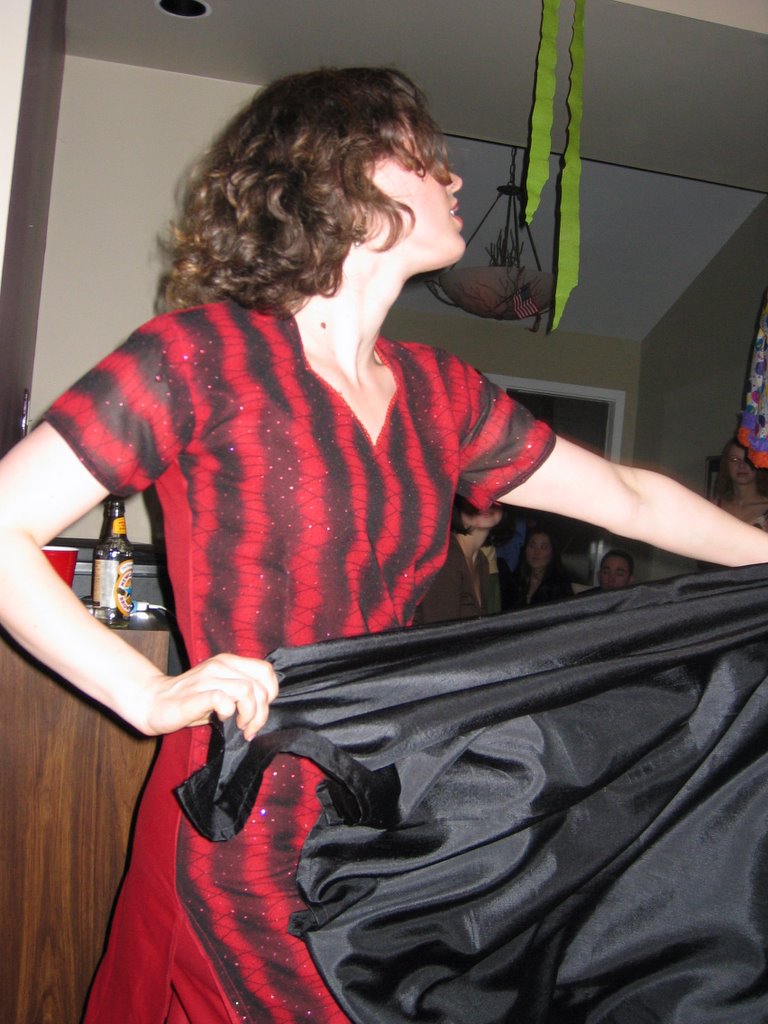
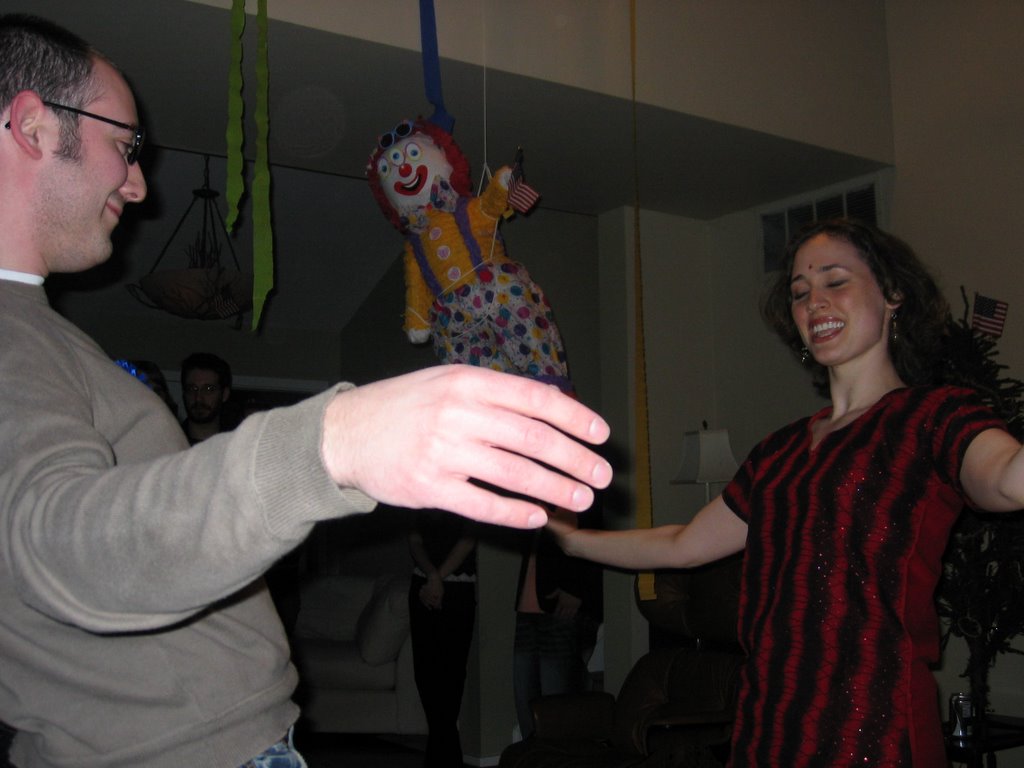
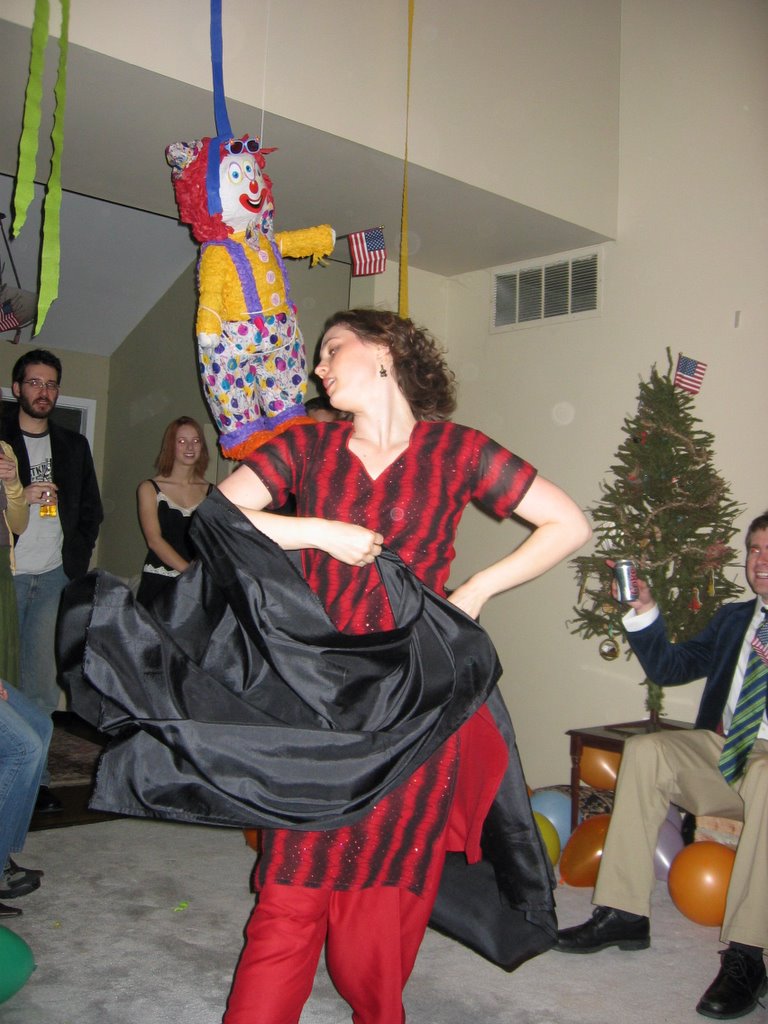
Before I attempt to introduce JPII's "Interpretation of the Sexual Urge," I'd just like to say that last night was my first dance performance "gig". I performed a 15 minute set to Turkish and Egyptian music for some friends' birthday party. I had a blast, and I think the performance was a smashing success with the crowd. Good times.
My beloved roomie and I.
(Thanks for taking these shots!)

Caught by the birthday boy!

Hello there.

Here, hold my veil; I insist.


Make room. Coming through.

"The Unveiling" or "I am Bat Girl"-
whichever you prefer

No matter how many times I hip-drop,
I just can't make myself Persian.
Dang it.

He just ain't no good for me.

He is mesmerized by my veil.
Or maybe he's in a drunken stupor.

I challenge you to a shimmy.

The piƱata clown gets it.
Why doesn't anyone else get it?

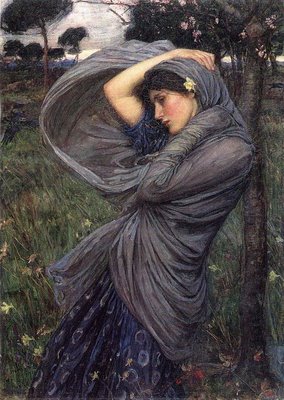
"The Tempest"

Dance, my Esmerelda, dance!

Blessings!
Natalie

Sunday, January 22, 2006

Roe & Doe (In Case You Don't Know)

January 22, 1973 - Roe vs. Wade ruled that most state laws against abortion are a violation of a a constitutional right to privacy. The Court then removed the right for any state to restrict abortions during the first trimester (3 months) of pregnancy. Roe does allow states to regulate abortions in the second and third trimesters so long as there are provisions for situations in which the "health" or life of the mother is threatened. [Transcript of Roe].

Doe vs. Bolton, Roe's companion case, also ruled that same day to define "health" of the mother to include "all factors-physical, emotional, psychological, familial, and the woman's age-relevant to the well-being of the patient." In a nutshell, January 22 of this year marks 33 years since our federal government made abortion legal through all 9 months of fetal development for virtually any reason throughout all 50 states.

I'd like to point out here that if a woman's life is truly at risk during a pregnancy doctors should seek to save her life as well as her unborn child. The original Hippocratic oath required physicians to pledge to "do no harm" to any patient. Both mother and child are patients because both are living human beings. The Oath also states, "To please no one will I prescribe a deadly drug nor give advice which may cause his death. Nor will I give a woman a pessary to procure abortion." The Catholic Church teaches that no one should ever directly and intentionally destroy the life of an unborn person. We are never to perform an intrinsically evil act (i.e. taking a human life) so that good may result. In fact, even if a child has implanted in a woman's fallopian tube (which will ultimately lead to a rupture of the tube, hemorrhaging within the woman, and the death of the child) the Church does not condone the direct destruction of the child in the womb via suction methods or what have you. Rather, the doctor should remove the portion of the tube which will ultimately rupture and could kill the mother. The child will be inside of this part of the tube, and the doctor must allow the tiny child to die naturally. There is no way to make a child re-implant in a woman's uterus that I am aware of and during this early period the child could certainly not survive outside of the protective, nurturing environment of her mother's body. If during a legitimate operation or treatment to save the mother's life, her child is indirectly harmed or killed, this is morally different than an abortion.

If Roe is ever overturned it will not make abortion illegal in the U.S., but rather each state government will be handed back the reigns to regulate abortion within their own state. I dream of seeing states outlaw abortion completely. It would be a brutal state-by-state battle to achieve this dream, though. Senator Rick Santorum writes in his 2005 book It Takes A Family, "Laws have meaning, and therefore, laws teach. When something is legal it has the presumption that it is moral and right" (34). Many Americans cannot imagine a United States without legalized abortion on demand. We have been in a "culture of death" (John Paul II's words) for 33 years, and many of us have embraced the "right" to abortion as an inalienable human right. As my priest put it this morning, the culture of death values life, but only life that it chooses to value. It is a schtzophrenic culture in this sense.

Senator Santorum goes on to explain in It Takes A Family that the freedom America's Founding Fathers sought to secure at the Constitutional Convention was not the "self-centered, No-Fault Freedom" we hold so dear today. He explains: "It wasn't a freedom that celebrated the individual above society. It wasn't a freedom that gave men and women blanket permission to check in and out of society whenever they wanted. It wasn't the freedom to be as selfish as I want to be. It wasn't even the freedom to be left alone, with no obligations to the people we know and to the people we don't yet know. The Constitutional Convention's freedom, American's traditional freedom--or the better word, as I defined it earlier, liberty--was a selfless freedom, freedom for the sake of something greater or higher than the self. For our founders, this liberty was defined and defended in the context of our Judeo-Christian understanding of humanity. Often, in fact, American liberty meant the freedom to attend to one's duties--duties to God, to family, and to neighbors. Our founders were in the business of constructing a nation, a political community. No-Fault Freedom, a freedom from every tie and duty, provides no basis for that project: it is a principle of division and social deconstruction." (44)

We as Americans no longer conceive of ourselves as a people with a "common vision for society", with a shared "sense of justice and morality" (45). Santorum continues: "It is the pursuit of the common good, f using our freedoms to promote the general welfare, that makes the Great Experiment of American democracy so remarkable. But today, it must be said, we have not always been good stewards of our founding fathers' freedom. . . . The Preamble has been long forgotten; freedom is increasingly just about the individual and his choices. Freedom has become its own end, and virtue has fallen out of the equation. No-Fault Freedom serves no common good, only the pursuit of one's own happiness. Promoting the general welfare is no longer considered a duty of citizens-- after all, that's why we have the government, right?"

". . . Just as original sin is man's inclination to try to walk alone without God, individualism is man's inclination to try to walk alone among his fellows. Under the spell of individualism, we splinter into pursuing what each of us considers important for ourselves and think little if anything about what might be important for our communities. And we do so not necessarily for any grand reason or purpose, but merely because it is more convenient, merely because it is easier." (52)

In the 1992 U.S. Supreme Court decision Planned Parenthood vs. Casey, the Court wrote, "At the heart of liberty is the right to define one's own concept of existence, of meaning, of the universe, and of the mystery of human life." Santorum comments on this case in his book, "You cannot build a community that is healthy for families and individuals if you understand society only as an unconnected group of individuals, each pursing his own idiosyncratic vision of his self-centered good. That isn't our founders' vision of a community with a common good; it's an image of society as a pile of sand, each grain unconnected to all the others. And the common good, like a house build on sand, sinks and fractures. No, No-Fault Freedom is not American liberty." (53)

This book is so good, I have to quote just one more paragraph before I conclude. I highly recommend this book to you, by the way.

"The Bill of Rights, the first ten amendments to the federal Constitution, enshrines our inalienable rights as a free people. Through the responsible use of these rights we can seek truth and the Truth Giver, marry and raise a family, pursue our dreams, and influence the government and each other. These are opportunities that every American inherits from the great document that is our Constitution. Yes, these are rights that belong to us as individuals. But these rights were never intended solely for individual gain for 'the individual welfare.' The framers clearly stated that the purpose of the Constitution--and, therefore, of all these individual rights--is to promote the general welfare, not simply the welfare of the individual. The men who wrote the Constitutions gave us, in the Preamble, a purpose for these personal freedoms--a purpose greater than the needs, wants, or dreams of any one person. Freedom's goal in their mind was not individuals pursuing whatever end fits an individual's desire, but the general welfare, the common good." (47-48)

I pray that each of us living in this day and age in America (and elsewhere) will embrace the "culture of life" worldview that John Paul II promoted. I want to see communities where people know each other and feel responsible towards their neighbors and their neighbor's children - to promote morality in their community for the common good. I ask God to show us each what we can do in the small piece of earth where He has placed each us and with the human persons He has set us among. Please pray, also.

Monday, January 16, 2006

Warming Up for JPII's "Interpretation of the Sexual Urge"

Where JPII is headed in his book Love & Responsibility is toward a thorough, philosophical analysis of sexual morality in regards to male-female sexual union. He has just told us that justice and love are interconnected. It is just to love and affirm a person because that is what persons are designed for. Also, in loving someone, wel naturally treat them justly . . . because we love them.

JPII warns now that "in the sexual context what is sometimes characterized as love may very easily be quite unjust to a person" (43). Because sexual intimacy is usually pleasurable, our sensuality and sentimentality will greatly tempted to turn toward a quest for pleasure "for its own sake" (43). And eventually it is possible that one will begin to view the pleasure-seeking approach to male-female relationships as "the proper basis for a norm of behaviour" (43).

When it comes to a sexual relationship, there are two mindsets upon which we can choose to base our interactions: the utilitarian principle or the personalistic norm. JPII refers here to Saint Augustine's way of defining these two different mindsets. Seeking pleasure "for its own sake, with no concern for the object of pleasure" is what Augustine calls uti. When a person "finds joy in a totally committed relationship with the object precisely because this is what the nature of the object demands," (44) Augustine calls this frui.

When Christ commands us to love one another, He is calling us to frui. This personalistic, deeply human approach to love is also how we must approach sexual love . . . that is if we really want to experience to fullness of our gift of sexuality.

Stay tuned! Next time we will launch into JPII"s "Interpretation of the Sexual Urge."

Sunday, January 15, 2006

"Love is a Verb"

(So says DC Talk. :-)

At the end of the last entry I quoted JPII as saying that "love for a person must consist in affirmation that the person has a value higher than that of an object for consumption or use" (42). He goes on to say, "He who loves will endeavour to declare this by his whole behavior" (43). We all want to be loved, to be truly loved for who we really are. And we need to experience another person taking time to show us their love. (By the way, in the homily today at Mass our Pastor stressed that how we live our lives demonstrates what it is we most desire. We can show God our love by how we spend our time. Our Pastor especially exhorted us to spend time simply in prayer and meditation on Scripture as a way to know God and to love Him with our time.)

Anybody read The Five Love Languages by (Protestant author and counselor) Gary Chapman? I personally love the book. He has observed 5 major categories of ways that people express and receive love. The five major categories he gives are: 1. words of affirmation 2. physical touch 3. quality time 4. giving/receiving gifts 5. acts of service. It could be that my best girl friend tends to express love and receive love primarily through gifts, but I am more of a "words of affirmation" girl. So if she gives me a bracelet she bought on trip to Brazil (all hypothetical), I can understand that she is showing me how much she values me. However, I may not be particularly fond of knick knacks and trinkets or even jewelry, and therefore, I do not derive much pleasure from the gift itself but rather from knowing what that gift expresses. I in turn may frequently praise my friend for her maturity in handling difficult situations and her great fashion sense. She appreciates it, and knows that I am saying those things because I love and value her. But perhaps a hand-made card would have communicated my love even more loudly to her because for some reason such tangible gifts are her favorite way of receiving love.

Anyway, I think that the "love languages" concept is really fun to think about. The overarching message of the book is that when you love and care about someone, you are willing to make the effort to find out what makes them tick and to learn to express love to them in a way that speaks loud and clear to them personally. Again, we all long to be loved this way, for who we really are, and in such a way that another person's love for us affects their behavior profoundly.

Catholic psychologist Conrad W. Baars, M.D., and Anna A. Terruwe, M.D., discuss in their book Healing the Unaffirmed the innate need each of us has to be truly affirmed by another, to know we are valuable simply as we are. This affirmation frees us to become even more fully who we are, to become the best, most holy person we can be. It fills us with confidence. Here are some thoughts from the book:

"The most typical characteristic of mature human love is tenderness, whether manifested in the tone of voice, words, touch, or the way one looks at the beloved. People are tender because they sense another's goodness and beauty, because they realize how precious the other is. They take care to let the other person be, precisely because they love the other just the way he or she is at that moment." (184)

"It is through the tender touch, the tender look, the tender words and tone of voice that the child is affirmed in its own goodness, worth, and loveableness. The tenderness with which a mother cradles her infant in her arms, cuddles and caresses it, and presses it to her, is as primary in the order of importance as it is in the order of development. Without such tactile expressions of maternal love the child will develop later in life the most serious form of emotional deprivation disorder." (184)

" Similarly, such tender love leaves its unmistakable mark in the expression of the eyes. The tender gaze is characterized by repose and tranquility in the delight of contemplating the good. It reflects admiration and awe, as well as the joy of love. It changes in character as soon as one feels a desire to possess or direct the other to oneself. Nor does the other fail to sense this, for the will can mask or control the expression of the eyes only very slightly. . ." (185) [emphasis is my own]

"Only genuine love declares unequivocally to children that the other has recognized them as good and valuable. Only this love affirms their goodness and worth, and because this process takes place on the emotional level, in the sensory sphere, it becomes anchored in the soma, in the biological organism where it forms a lasting source of the feeling that children are a good for themselves as well as for others. Without it they may in later years arrive at the conclusion that they are good because of what they do: performing their duties, showing obedience, getting good grades at school, attaining success in their profession, and so forth. Yet this cognitive knowledge will never provide them with the feeling of self-love which is the indispensable requirement for the fullness of their existence as social beings. 'Man's being,' says Heidegger, 'is to be with others,' to commune with one's fellow human beings in a union of feelings, in mutual emotional rapport. The nature of people as social beings absolutely demands this emotional contact with others; they cannot become open to others unless they have first been affirmed by another's unselfish love. Without such affirmation they are doomed to a life of gnawing uncertainty about their own self-worth. No degree of professional or intellectual accomplishments, however outstanding or widely acclaimed, can make up for this emotional deficit. It can only be filled by the unselfish love of another person." (185-6).

I John 3:18 "My little children, let us not love in word or in tongue, but in deed and in truth."

I John 5:2-3 "This is how we know that we love the children of God: by loving God and carrying out his commands. This is love for God: to obey his commands. And his commands are not burdensome . . . ."

James 2: 14-26 "What good is it, my brothers, if a man claims to have faith but has no deeds? Can such faith save him? Suppose a brother or sister is without clothes and daily food. If one of you says to him, 'Go, I wish you well; keep warm and well fed,' but does nothing about his physical needs, what good is it? In the same way, faith by itself, if it is not accompanied by action, is dead.

"But someone will say, 'You have faith; I have deeds.'
Show me your faith without deeds, and I will show you my faith by what I do.

"You believe that there is one God. Good! Even the demons believe that—and shudder.
You foolish man, do you want evidence that faith without deeds is useless? Was not our ancestor Abraham considered righteous for what he did when he offered his son Isaac on the altar? You see that his faith and his actions were working together, and his faith was made complete by what he did. And the scripture was fulfilled that says, "Abraham believed God, and it was credited to him as righteousness,"and he was called God's friend. You see that a person is justified by what he does and not by faith alone. In the same way, was not even Rahab the prostitute considered righteous for what she did when she gave lodging to the spies and sent them off in a different direction? As the body without the spirit is dead, so faith without deeds is dead."

Saturday, January 14, 2006

The Personalistic Norm

Guess what time it is? It's time for the personalistic norm! Yeah!!! But first . . . a few words from our Sponsor:

Deuteronomy 4:4-6 "Hear, O Israel: The LORD our God, the LORD is one. Love the LORD your God with all your heart and with all your soul and with all your strength. These commandments that I give you today are to be upon your hearts."

Leviticus 19:17-18 "‘You shall not hate your brother in your heart. You shall surely rebuke your neighbor, and not bear sin because of him. You shall not take vengeance, nor bear any grudge against the children of your people, but you shall love your neighbor as yourself: I am the LORD."

Matthew 22:37-40 "Jesus said to him, ‘"You shall love the LORD your God with all your heart, with all your soul, and with all your mind." This is the first and great commandment. And the second is like it: "You shall love your neighbor as yourself." On these two commandments hang all the Law and the Prophets.'” (NKJV)

Okay, now . . .

The personalistic norm, as articulated by JPII, confirms that "the person is a good towards which the only proper and adequate attitude is love" (41). In the "negative" definition, the personalistic principle "states that the person is the kind of good which does not admit of use and cannot be treated as an object of use and as such the means to an end" (41). Wow!

JPII explains that the command to love persons is not the personalistic norm in and of itself, but rather, Christ's command to love is based on the personalistic norm. See, we have to be told these sorts of things or else we'll just go on acting selfishly and using people for our own personal gain either out of malice or ignorance. But now we know . . . and as "they" say, "Knowing is half the battle." (Hmmm . . . I think that might be relevent to the concept of faith AND works vs. faith alone. Knowing, accepting, and believing something is all nice and good . . . but you've gotta put it into action. That's how you know that you really know and believe something from the depths of your being.)

The commandment to love is not derived from a utilitarian value system that prioritizes pleasure over love for the person. Nope, indeed. The personalistic norm, however, is part of an entire system of values that JPII calls "a personalistic axiology" (41). Within the framework of a personalistic axiology "the value of the person is always greater than the value of pleasure (which is why a person cannot be subordinated to this lesser end, cannot be the means to an end, in this case to pleasure!)" (41).

Again, the command to love presupposes the personalistic norm, and the personalistic norm provides "a justification for" the command to love (41).

Ahhhh. I just love John Paul II. And that's why I'm now going to quote another beloved and lengthy passage from Love & Responsibility. ;-D

"This norm, as a commandment, defines and recommends a certain way of relating to God and to people, a certain attitue towards them. This way of relating, this attitude is in agreement with what the person is, with the value which the person represents, and therefore it is fair. Fairness takes precedence of mere utility (which is all the utilitarian principle has eyes for) - although it does not cancel it but only subordinates it: in dealings with another person everything that is at once of use to oneself and fair to that person falls within the limits set by the commandment to love."

". . . this attitude, will be not only fair but just. For to be just always means giving others what is rightly due to them. A person's rightful due is to be treated as an object of love, not as an object for use. In a sense it can be said that love is a requirement of justice, just as using a person as a means to an end would conflict with justice. In fact the order of justice is more fundamental than the order of love - and in a sense the first embraces the second inasmuch as love can be a requirement of justice. Surely it is just to love a human being or to love God, to hold a person dear. At the same time love - if we are to consider its very essence - is something beyond and above justice; the essence of love is simply different from the essence of justice. Justice concerns itself with things (material goods or moral goods, as for instance one's good name) in relation to persons, and hence with persons rather indirectly, whereas love is concerned with persons directly and immediately: affirmation of the value of the person as such is of its essence. Although we can correctly say that whoever loves a person is for that very reason just to that person, it would be quite untrue to assert that love for a person consists merely in being just" (42).

Saturday, January 7, 2006

Never weak, but always strong?


I have the song "It Ain't Me, Babe" by Johnny Cash and June Carter running through my head. At one point Cash sings, "You say you're looking for someone who's never weak but always strong, to protect you and defend you whether you are right or wrong." And then he proceeds to explain that "it ain't me you're lookin' for." It's almost a humorous song, but it's also sad.

It seems that men often get the impression that a woman is looking for perfection in them. This is a lot of pressure, indeed. I can see why many men feel this way. This song seems to express the high expectations men often feel that women have of them. And I'm sure that many a woman (not only today, but throughout the course of history) have sought a savior in a relationship with a man. As Christopher West says in his talk Sex and the Meaning of Life, whenever any person expects another person to be their savior and to make them happy in every way, they will crush that other person. He says, "Do not hang your hat on a nail that cannot support the weight."

"It Ain't Me, Babe" seems to paint a picture of how a man can feel extreme pressure from a woman to be perfect in every way according to her standard of perfection. Cash (along with Carter) sings of his frustration and resignation, "It ain't me, babe. It ain't me you're lookin' for, babe." And there is also a sense in the song that he does not love this woman and is not interested in making sacrifices for her. I have no clue what Cash or Carter thought about this song.

When Cash sings that this woman wants "someone who is never weak but always strong," I think, "Most women don't want that." I'm not saying I, or any other woman, desire a husband who is wimpy, passive, effeminate, or overly emotional. Somewhere in Wild At Heart, John Eldredge describes a difficult period in his marriage, and whenever he and his wife finally discuss what is wrong she tells him, "You don't need me." It is built into a woman to be a nurturer, and a woman desires to be needed, even by her husband. Women like to be able to encourage and to comfort at times.

Ponder these lyrics from a few other songs:

"Made for You" by Watermark (a husband and wife duo, Nathan and Christy Nockels):

Nathan: "Darling, I need to confess,
it's hard to show my weaknesses.
I want so much to show you strength,
With every feeling . . . everything."

Christy: "You know what I always say.
When you're weak you're strong to me;
It's another way of loving me.
'Cause when I see your heart,
I get carried through
The reasons why I fell in love with you."

"Til Kingdom Come" by Coldplay:

"Hold my hand inside your hands,
I need someone who understands.
I need someone, someone who hears,
For you, I've waited all these years.

For you, I'd wait 'til kingdom come.
Until my day, my day is done.
And say you'll come, and set me free,
Just say you'll wait, you'll wait for me."

"You are like Coming Home" by Lonestar:

"Go ahead and let your hair fall down.
This wanderlust: it's gone now.
I'm here in your arms; I'm safe from the road again.
These are the days that can't be erased:
Baby, there isn't a better place;
You're like heaven; you're like coming home.

You're like a Sunday mornin', pleasin' my eyes;
You're a midsummer's dream under a star-soaked sky,
That peaceful easy feelin' at the end of a long, long road.
You're like coming home.

You're that innocence, that serenity,
That long-lost part of me."

[ Oh, the complimentarity of the sexes. Gotta love it. ;-) ]

"To Really Love a Woman" by Bryan Adams:

"When you find yourself lying helpless in her arms,
You know you really love a woman."

[Among other images this last line conjures, I picture Christ as a helpless infant sleeping on Mary's lap and also Christ lying lifeless in His mother's arms after His removal from the cross on which He was crucified. The ultimate man Himself loved a woman and gave Himself to be loved by her.]

I had heard somewhere that after the Fall, men have a tendency to objectify women and women have a tendency to worship men. We see this everywhere! Women will take horrendous physical abuse or abort their own child in order to keep the "love" of a particular man. This is the nurturing instinct turned against the woman and used as a weapon. (Yeah, Satan has a way of doing that with good things, and we're all hopeless without God's revealed truth since the Fall.) I wonder if this problem is what God meant when he told Eve after she and Adam ate the forbidden fruit, "Your desire will be for your husband, and he will rule over you." Hmmmmm???

Anyway, just some thoughts that were running through my mind. ;-)

Blessings.
Natalie

Friday, January 6, 2006

Beauty


"Finally, brothers, whatever is true, whatever is noble, whatever is right, whatever is pure, whatever is lovely, whatever is admirable—if anything is excellent or praiseworthy—think about such things" (Philippians 4:8)

The man to his beloved: "My love, you are as beautiful as Jerusalem, as lovely as the city of Tirzah, as breathtaking as these great cities. Turn your eyes away from me; they are holding me captive. . . . Who is this whose glance is like the dawn? She is beautiful and bright, as dazzling as the sun or the moon" (Song of Songs 6:4,5, 10 TEV).

This morning I woke up way before my alarm. I just couldn't sleep any more. As I got up and prepared to go for a walk and to pray the Rosary, I could not stop thinking about George Weigel's reflections on beauty in Letters to a Young Catholic. Perhaps this was on my mind because I went to sleep fantasizing about art work that I'd like to buy to hang in my bedroom.

Weigel writes:

"Chartres . . . teaches us about the importance of beauty and the beautiful for Catholic faith. The sad fact is that a lot of contemporary Catholicism is ugly: ugly buildings, ugly furnishings, ugly decorations, ugly vestments, ugly music. There are exceptions, huge exceptions, to be sure. But the general Catholic drift in the United States is not, to put it gently, toward the beautiful. That's not just an aesthetic problem. It's a serious religious and theological problem.

"Why? Because beauty helps prepare us to be the kind of people who can be comfortable in heaven--the kind of people who can live with God forever. Beautiful things and beautiful music draw us out of ourselves and into an encounter with a truth that's beyond us, yet accessible to our senses. . . . The beauty that, by its very nature, draws us out of ourselves is an antidote to self-absorption. The beauty of Beatrice drew Dante [The Divine Comedy: Paradisio] out of himself and into paradise, and into an encounter with the beauty that is Love itself. The same experience is available to us in our encounters with the beautiful.

"The joy of beauty is another anticipation of the kingdom, and another way that we're prepared for the kingdom. How are we to become the kind of people who can be happy forever--especially those of us who are congenitally grouchy? Beauty, by giving us experiences of unalloyed joy here and now, prepares us for that dimension of life with God. So does beauty's inexhaustibility--the fact that we never tire of a beautiful painting, sculpture, building, poem, or piece of music. . . . The inexhaustibility of beauty . . . is another reason why beauty prepares us for, even as it anticipates, life in the kingdom, life with God forever. As Hans Urs von Balthasar once wrote, the more we know and love and understand a great work of art, the more we recognize that we can't, in the final analysis, 'grasp' its genius. That's why we never 'outgrow' a beloved work of art. And that inexhaustibility prepares us to 'contemplate God in the beatific vision, [when] we will see that God is forever the ever-greater.'

"So beauty helps deepen in us a sense of our human and spiritual destiny, which is life forever in the light and love of the Holy Trinity. . . .

"Beauty is something that even the most skeptical moderns can know. Balthasar once wrote that people who doubt they can say what's good or what's true can't be similarly skeptical about the meaning of beauty, once they've experienced it. People know that they know what's beautiful. Thus beauty is one way we can introduce our doubting friends and colleagues to the mystery they often deny: they mystery that there is truth and we can know it. Once they've crossed the bridge of radical skepticism, the results can be dramatic and surprising. You'll remember Father Jay Scott Newman from an earlier letter. It's worth noting that the Gothic beauty of the Princeton chapel played a considerable role in breaking him free from the rationalistic atheism he had adopted as a teenager and bringing him to Christ.

"All of which takes us back to the great theological mentor of the Middle Ages, St. Augustine, and his Confessions. In perhaps the most famous and lyrical moment in this first true autobiography, Augustine takes himself to task for his resistance and then exults in his surrender to the God who is Beauty itself:

Late have I loved thee, O beauty ever ancient, ever new, late have I loved thee! You were within, but I was outside, and it was there that I searched for you. In my unloveliness I plunged into the lovely things which you created. You were with me, but I was not with you. Created things kept me from you; yet if they had not been in you they would not have been at all. You called, you shouted, and you broke through my deafness. You flashed, you shone, and you dispelled my blindness. You breathed your fragrance over me; I drew in my breath and now I pant for you. I have tasted you, and now I hunger and thirst for more. You touched me, and I burned for your embrace

"The Catholic spirit can't live without beauty; the human spirit can't live without beauty. . . . Everyone needs beauty. We need it for our souls. We need beauty to prepare our souls, and the rest of us, for what lies ahead, when we come home at last.

". . . An increasing number of Catholics pray with icons in their homes. Why?"

"In part, I suspect, because of a reaction to the not infrequent ugliness I have already mentioned. Even the most sterile cinder block 'worship space' (another of those awful AmChurch neologisms) is ennobled by an icon. Post- Vatican II Catholics may be discovering the power of icons after too many preconciliar decades of religious 'art' that was, truth to tell, shlock. But whether it's in response to modern AmChurch ugliness or old-fashioned Catholic bad taste, the new interest in icons is instructive for the same reason that Chartres is instructive--it tells us that beauty and prayer go together.

"When Chartres invites us out of ourselves into a realm of luminous beauty, it's inviting us, however gently, to pray. The brilliant craftsmen who put those extraordinary blues and reds into the glass of Chartres . . . the glass they made was an invitation to a wider and deeper vision of the human estate, a vision that necessarily leads to praise and thanksgiving, intercession and contrition--in a word, to prayer. The same is true of icons. I think that's what so many people who now buy icons or applaud the erection of icons in their churches intuitively understand.

"As we've discussed before, we don't merely look at icons; we look through them and discover ourselves engaged with the Truth the iconographer has written. We meet the truth of Christ through [them] . . . . Beauty is an invitation to pray. The God who is Augustine's 'Beauty ever ancient, ever new' pours beauty into the world as one facet of his thirst for us. God asks us to drink at the wellspring of beauty here and now in order to drink, finally, of his own ineffable and inexpressible and inexhaustible beauty in the New Jerusalem.

"Through the beauty of Chartres we encounter what the early Greek Fathers of the Church called the 'divinization' of man. Cardinal Christoph Schonborn, O.P., the archbishop of Vienna, reminds us that this 'divinization' of man is made possible by what the cardinal calls 'the humanization of God'--the Incarnation. When God enters history in the flesh, history isn't the only thing radically transformed; so are the possibilities of the human. Through the Incarnation, human nature is led to its fulfillment, its completion.

"That's the truth shining through the ineffable blues of the Chartres windows. That's the truth that makes every icon possible. That is grace at work--God's outpouring of his superabundant life into the world and into our lives. Like Augustine, we burn for the embrace of the Beauty that is always the same and always new. That burning, which God himself has built into us, is the beginning of every prayer" (198-206).

The beauty of an epic film often moves me to prayer on a deeper level than I typically experience day in and day out. There is something about such a film that awakens the depths of my humanity and causes me to cry out for more of the beauty of God. I hope that if I do ultimately pursue Middle Eastern dance performance publicly that my dancing will be an act of beauty and an invitation to prayer. "To the pure, all things are pure, but to those who are corrupted and do not believe, nothing is pure. In fact, both their minds and consciences are corrupted" (Titus 1:15). We'll see.*

Peter Kreeft in Catholic Christianity had the following to say about beauty:

"The experience of beauty often leads to God more directly and intuitively than does a process of argument. 'There is the music of Mozart, therefore there must be God'--you either see this or you do not."

"Our desire for joy, for a joy we can never find in this world, even from other people, points to another world (heaven) and another Person (God): for every natural, innate, and universal desire corresponds to a reality that can satisfy it. The reality of hunger shows the reality of food; the same is true of the hunger for God and heaven" (34).


* This passage captures my heart's desires to romance others to God through the beauty of my dance performances . . . one day.

The Women: "Dance, dance, girl of Shulam. Let us watch you as you dance.

The Woman: "Why do you want to watch me as I dance between the rows of onlookers?"

The Man: "What a magnificent girl you are! How beautiful are your feet in sandals. The curve of your thighs is like the work of an artist. A bowl is there, that never runs out of spiced wine. A sheaf of wheat is there, surrounded by lilies. Your breasts are like twin deer, like two gazelles. Your neck is like a tower of ivory. Your eyes are like the pools in the city of Heshbon, near the gate of that great city. Your nose is as lovely as the tower of Lebanon that stands guard at Damascus. Your head is held high like Mount Carmel. Your braided hair shines like the finest satin; its beauty could hold a king captive."

Song of Songs 6:13 -7:5 TEV

(You know, from the sound of that last passage of Scripture, I'm thinking I should say that at least I can romance my some-day husband to reflect on God. Haha. That book is so steamy. Only my husband would be allowed to say after seeing me dance, "Your breasts are like two gazelles." And he'd better be joking. Haha.)

Tuesday, January 3, 2006

Don't be jealous . . .

". . . because I've been chatting with hot babes on-line all day." (- Kip "So Dreamy" Dynamite)

Rather, be jealous because I got a speeding ticket today and you didn't. However, I am willing to give anyone who is interested pointers on how to get your own speeding ticket. I would say the secret of success begins with losing directions to an appointment, leaving late for said appointment and following the directions as best you can remember until you are headed into the wrong county. Then, once your doctor realizes that you are not there at the appointed time, be sure to answer your cell phone and have a lengthy discussion with him about where you are and where you are not. As he tries to look up directions on Mapquest, be sure to turn down a road where there is a school zone. But, and this is key, remain frazzled enough that you will not realize there is a school zone, and proceed at your usual 40 mph. Then, if you see a young man wearing a safety green vest jump in front of your vehicle and flag you over to the side of the road, be sure to say, "Damn it, I just got pulled over by a cop. I'll have to call you back." While you are doing this, you must simultaneously step on the brakes causing your address book to fly out of your lap and into the floorboard at your feet.

Not only is this successful for obtaining a speeding ticket, but it also provides the perfect opportunity to have a good cathartic cry while the officer is at his vehicle doing a background check. Not only is life romantic, but it's also really funny! Okay, now it's your turn!


*The above story is not the "personalistic norm," neither is it the norm for me personally. ;-D

Monday, January 2, 2006

"The cheese is old and moldy. Where is the bathroom?"

I love that part in Encino Man. Okay, now down to business. . .

What I love about reading through Love & Responsibility is that I feel as if I am sitting at Christ's feet, asking questions like, "What exactly do you mean 'love' my neighbor?", and getting a detailed response. When Christ was on earth, He once explained that to even look upon a person lustfully is to have already committed sexual sin in our hearts. I'm sure he could have elaborated, but since the Bible is not a book of systematic theology or moral philosophy, this is where we must rely on the Church. God has given us nearly 2000 years of guidance and teaching via His instrument, the Church, and her leaders. And now I can sit at JPII's feet and get detailed answers to my questions as from the very lips of Christ our Lord Himself. (*sigh of comfort*)

Well, L&R is a bit repetitive. But I really need that, so I am thankful for it. And now, I will repeat what has basically been said in all previous posts.

We are commanded by Jesus to love God first and foremost, and to love our neighbors (all persons) as ourselves. God is "the most perfect personal being," and "the whole world of created persons derives its distinctness from and its natural superiority over the world of things (non-persons) from a very particular resemblance to God" (40).

The utilitarian principle "points to pleasure not only as the basis on which we act but as the basis for rules of human behavior" (40). Utilitarianism has its own set of values, "that according to which pleasure is not only the sole, but also the highest value" (40-1). Such an approach to persons can never lead to love. I made a note in the margins of my book, "Funny how you can experience great physical pleasure with someone yet have a negation of pleasure emotionally because you do not truly love the person or they do not truly love you." And how. JPII says, "The principle of 'utility' itself, of treating a person as a means to an end, and an end moreover which in this case is pleasure, the maximization of pleasure, will always stand in the way of love" (40).

A friend recently commented to me over coffee (you know who you are ;-D) that our society has lost the concept of sacrifice. He's so right. All around me I see relationships based on the pleasure principle, and then when things get tough and sacrifice is required on behalf of one or both parties, somebody decides to split. I'm sure many of us have been there ourselves. That is no mui bueno. (Yeah, I don't speak Spanish.)

It's easier to say this now, while my life is going nicely, but I think sacrifice is one of the greatest privileges of living. It is a solid way to really love another person. And to love another person and give your life for them fulfills our own God-given desire for love. Fascinating.

Next time I write, I'll be picking up with what JPII calls the "personalistic norm". Stay tuned. ;-D

Blessings!!

Friday, December 23, 2005

Peanut Butter, Planes, and Procreation

So, I have arrived safely in Tejas to spend this Christmas with my family. As I prepare to be confirmed in the Catholic Church this coming Easter, I have been reading through Peter Kreeft's book Catholic Christianity. I do love it. I brought it along on my flight, in addition to a smashed peanut butter and jelly sandwich and a baggy of broken Saltine crackers. (*drooling*) Hey, at least I didn't have to pay an arm and a leg to eat some MSG-saturated Chinese food at the airport, as much as I love to eat Chinese food.

I had my first introduction to teachings on sexual abstinence until marriage (via a Baptist church) when I was 12. It's been over a decade since then, and although sexual purity is very important to me, I often feel like there is nothing particularly gripping left to say on the subject. I feel that I have heard it all. However, as I began my journey towards Catholic Christianity, I discovered that the Church goes beyond "abstinence" and upholds what is known as "chastity." Chastity is much more than simply abstaining from sex until marriage; it involves living all of one's life before God in purity. It requires seeking purity of heart and mind, as well as purity of action. Spouses are to practice chastity in their relationship with one another, sexually and otherwise. Sexual marital chastity involves honoring the human dignity of one's spouse in sexual actions. This is why the Catholic Church teaches against things like sodomy, barriers and artificial "birth control", and climax outside of the intended sexual embrace. They are a means of treating one's spouse as an object for pleasure.

Well, Peter Kreeft has indeed blown-me-out-of-the-water with his observations on the marital sexual union. This stuff is revolutionizing how I think. In the Bible, it is written, "As a man thinketh, so he is" (sorry, I don't know the "address"). Guess this is why we are called by God to "renew our minds" and seek His help in surrendering our twisted perceptions and misguided affections to Him while seeking His truth (see Romans 12:2 and Ephesians 4:23).

Kreeft begins laying the foundation for grasping the truth about God's design for human sexuality as quoted below:

"To create a thing is to give it existence. To make a thing means to give new form to matter, to something that already exists. What is created is not just changed but made to exist in the first place.

"The closest man ever comes to creating is 'procreating'. Procreating is cooperating with God's most important act of creation . . . the creation of human beings, with immortal souls, destined to exist eternally. When God creates a new human soul out of nothing, he does so only when a man and a woman make a new body out of their previously existing matter and genetic form by sexual intercourse. That is why sex is holy" (45)

Are you ready for this? Kreeft picks up . . .

"Sexual intercourse is like the Consecration at Mass. It is a human work that God uses as the material means to do the most divine work done on earth. In the Mass, man offers bread and wine, the work of nature and human hands, for God to transform into the Body and Blood of Christ. In sex, man offers his work--the procreation of a new body--for God to do his work: the creation of a new soul. God grants priests the incredible dignity of being his instruments in working one of his two greatest miracles. God grants spouses the incredible dignity of being his instruments in working the other one.

"Something that is so very good 'ontologically', that is, in its being, essence, or nature, needs to be respected and rightly used. Misuse of something ontologically good is morally bad. The better and more important it is ontologically, the more seriously harmful its moral abuse is. We have rules for careful use of precious works of art, not for paper clips. . . .

"As Holy Mass is the place for the Transubstantiation, holy marriage is the place for sex" (61).

I never want to grow tired of this stuff; I want to truly know it so that I may live it from the depths of my being!

Merry Christmas!
Natalie

Sunday, December 18, 2005

Subjective Sweethearts

Immanuel Kant is known for his moral imperative against utilitarianism - holding that a person should always be an end in himself and never a means to an end. Utilitarianism cries, "Seek the maximum amount of pleasure for the greatest number of people." If the ultimate aim of man is pleasure, if pleasure is "the whole basis of moral norms" (37), then everything we do must be aimed at gaining pleasure, the ultimate good. JPII writes, "If I accept the utilitarian premise I must see myself as . . . an object which may be called upon to provide [pleasurable] experiences for others" (37).

JPII continues:

"If, while regarding pleasure as the only good, I also try to obtain the maximum pleasure for someone else - and not just for myself, which would be blatant egoism - then I put a value on the pleasure of this other person only in so far as it gives pleasure to me: it gives me pleasure, that someone else is experiencing pleasure. If, however, I cease to experience pleasure, or it does not tally with my 'calculus of happiness' - (a term often used by utilitarians) then the pleasure of the other person ceases to be my obligation, a good for me, and may even become something positively bad. I shall then - true to the principles of utilitarianism - seek to eliminate the other person's pleasure because no pleasure for me is any longer bound up with it - or at any rate the other person's pleasure will become a matter of indifference to me, and I shall not concern myself with it" ( 38).

Viewing pleasure, a subjective and ephemeral experience, as one's greatest good leads to egoism. Well, yeah, we all want to feel good. We are all largely looking out for our own desires, right? So what's the problem with that?

Glad you asked. ;-D According to JPII, if you ever want to experience a true and lasting love, it must be built on an objective common good, not a subjective good such as pleasure. Although it is possible to harmonize two egoisms, the relationship still remains based on egoism. The only difference is "that these two egoisms, the man's and the woman's, will match each other and be mutually advantageous. The moment they cease to match and to be of advantage to each other, nothing at all is left of the harmony. Love will be no more, in either of the persons or between them, it will not be an objective reality, for there is no objective good to ensure its existence. 'Love' in its utilitarian conception is a union of egoisms, which can hold together only on condition that they confront each other with nothing unpleasant, nothing to conflict with their mutual pleasure. Therefore love so understood is self-evidently merely a pretence which has to be carefully cultivated to keep the underlying reality hidden: the reality of egoism, and the greediest kind of egoism at that, exploiting another person to obtain for itself its own 'maximum pleasure'. In such circumstances the other person is and remains only a means to an end, as Kant rightly observed in his critique of utilitarianism" (39).

A utilitarian relationship has "a paradoxical pattern: each of the persons is mainly concerned with gratifying his or her own egoism, but at the same time consents to serve someone else's egoism, because this can provide the opportunity for such gratification - and just as long as it does so. This paradoxical pattern . . . means that the person . . . sinks to the level of a means, a tool. . . . If I treat someone else as a tool in relation to myself I cannot help regarding myself in the same light. We have here something like the opposite of the commandment to love" (39).

JPII observes that the only way to escape from utiliarianism and egoism in relationships if to recognize "beyond any purely subjective good, i.e. beyond pleasure, an objective good, which can also unite persons - and thereby acquire the characteristics of a common good" (38). He continues, "Such an objective common good is the foundation of love, and individual persons, who jointly choose a common good, in doing so subject themselves to it. Thanks to it they are united by a true, objective bond of love which enables them to liberate themselves from subjectivism and from the egoism which it inevitably conceals. Love is the unification of persons" (38).

Wednesday, December 7, 2005

Pleasure or not . . . here I come

God said "It is not good for the man to live alone. I will make a suitable companion to help him." And so God gave to Adam animals of all kinds, and yet "not one of them was a suitable companion to help him. . . "

"Then the LORD God made the man fall into a deep sleep, and while he was sleeping, he took out one of the man's ribs and closed up the flesh. He formed a woman out of the rib and brought her to him."

"Then the man said, "At last, here is one of my own kind--Bone taken from my bone, and flesh from my flesh. 'Woman' is her name because she was taken out of man." (Gen. 2:18, 20-23 TEV)

Because only another human being shares equal status with another human being, only two persons can truly become "partners" in activity with one another. JPII says that "a person is for another person the source of experiences with a special emotional-affective charge" (32-3). The depths of personal and moral interaction that are possible between two persons bring with it great potential for pleasure as well as pain, emotionally, physically, psychologically, and spiritually. When we throw romantic relationships into the mix, the potential for pleasure and/or pain is something I'm sure we all can relate to.

Peter Kreeft, in his book Catholic Christianity makes a comment regarding "Social and Economic Morality" that is quite applicable to the issue of pleasure in human relationships. He writes:

"Profit is to production what pleasure is to sex: right and proper and natural when associated with the intrinsic purpose of the activity, but all too easily divorced from that purpose and loved for its own sake" (264).

JPII makes the same point in Love & Responsibility regarding the temptation for man and woman to make pleasure the "say all and be all" in their relationships with one another. He writes in his usual eloquent, philosophical style:

"For man, precisely because he has the power to reason, can, in his actions, not only clearly distinguish pleasure from its opposite [pain], but can also isolate it, so to speak, and treat it as a distinct aim of his activity. His actions are then shaped only with a view to the pleasure he wishes to obtain, or the pain he wishes to avoid. If actions involving a person of the opposite sex are shaped exclusively or primarily with this in view, then that person will become only the means to an end" (33).


After the fall, it has become an enormous temptation for us to use one another for the sake of physical and/or emotional pleasure. JPII says "enjoyment must be subordinated to love" (34). He warns us again that sometimes "use" masquerades as "love"; selfishness often justifies itself as being love.

The utilitarian principle is that pleasure in itself is "the sole or at any rate the greatest good, to which everything else in the activity of an individual or a society should be subordinated" (36). Of course, people want to avoid pain and experience pleasure by nature, but pleasure is an elusive thing; it is contingent and incidental, not something we can secure by our actions. In fact, we cannot even properly predict the degree of pain that may be entailed in our various actions. Obviously, pain and pleasure cannot be our measuring stick for the morality or worthiness of our actions.

Man is a rational being; he is a material and spiritual entity with his soul being the animating force of his human existence. It is, therefore, improper for man to organize his actions around the principle of avoiding pain and seeking to maximize pleasure.*

Because JPII says it best, I'm going to close with his thoughts:

". . . Pleasure (as opposed to pain) cannot be the only factor affecting my decision to act or not to act, still less the criterion by which I pronounce judgment on what is good and what is bad in my own or another person's actions. Quite obviously, that which is truly good, that which morality and conscience bid me do, often involves some measure of pain and requires the renunciation of some pleasure. The pain involved, or the pleasure which I must forego, is not the decisive consideration if I am to act rationally. What is more, it is not fully identifiable beforehand. Pleasure and pain are always connected with a concrete action, so that it is not possible to anticipate them precisely, let alone to plan for them or, as the utilitarians would have us do, even compute them in advance. Pleasure is, after all, a somewhat elusive thing" (36).


* This is not the case when it comes to eternal pain and eternal pleasure. We should rather endure temporal pain, on earth or in purgatory, in order to obtain the joy of being in God's presence forever and to avoid the eternal torment of separation from God in hell. That is proper to the nature and design of the human person.

Thursday, November 17, 2005

When is an act of love anti-love?

No, really, I'm asking you. What do you think? When is an act of love anti-love?

I ask because of Footnote 11 in JPII's Love & Responsibility. I am fascinated by this quote, but I can't quite wrap my mind around what it means and how it plays out in our lives. JPII writes:
"It is, of course, not enough just to want to affirm the other person for the consequent act (of goodwill) to become also an act of love. It is necessary in addition for the action undertaken with the intention of affirming another person to be objectively suited to the role which the agent's intention assigns to it. Whether it is or is not suitable is decided by the objective structure of the person affected by the action. Only success in understanding the other person and allowing when acting for that person's specific traits ensures that the act will be recognizable as a genuine act of love. An imperfect understanding of the structure of the object person must, in consequence become the source of (inadvertent and hence involuntary) action to the detriment of that person. The danger is all the greater in that utilization of the other takes place in the name of love. The agent is unaware of his delusion, and so immune from blame. None the less, the agent is responsible for an act of 'anti-love' . . . . because he loves. Only constant awareness of the danger of disintegration of love in this way (emotionalization) can help us to avoid it. Cf. Introduction o the first edition (Lublin 1960), p. 6, where the author postulates the need for 'the introduction of love into love'."

So, my darlings, enlighten me! Tell me your thoughts or questions about this passage.

Blessings!
Natalie

50 ways to use your lover

If it is not okay to use a person solely as a means to an end, then what do we do with other persons? We LOVE them! Love is the opposite of using. If "first comes love, then comes marriage, then comes the baby in the baby carriage", what comes before love?

The sharing of a common good or aim.

JPII writes in Love & Responsibility:
"Obviously, I may want another person to desire the same good which I myself desire. Obviously, the other must know this end of mine, recognize it as a good, and adopt it. If this happens, a special bond is established between me and this other person: the bond of a common good and of a common aim" (28).

Whenever two people share a common good, each of his own free choosing, then they see one other in relationship as equals. One is not "subordinated to the other," but rather both are "subordinated to that good which constitutes their common end" (29).

Unlike animals, love is "exclusively the portion of human persons;" love is predicated on free will, which animals do not posses as we do. Interestingly, just because someone shares a good end with another does not mean that they are truly able to love those others. It is possible to be utilitarian and to view another with a consumerist attitude while striving towards a good. Just because a man strives towards a good (i.e. protecting the unborn) does not mean he is willing to consciously pursue that good with others, subordinating himself to the good for the other's sake and subordinating himself to the others for the sake of the good.

JPII gives the example of employee/employer relations. It is clear that an employer can use his employee in a utilitarian fashion, to accomplish a company goal, but not really care about or get to know his employee as a human individual. They are both working towards a common good, but there is no love or common bond between them. (We are not yet speaking of romantic love here. Hopefully, that's obvious. ;-D) But it is also possible that both parties could be so persuaded of the goodness of their common aim, that they work together in a partnership, with an attitude akin to love, a camaraderie.

In marriage, it is possible that the man and woman acting together in their common sexual life, becoming one flesh (see Genesis 2:24), can use each other primarily as an object for sexual gratification. Married sex can still be selfish. JPII says the married couple should recognize that they share a common end. When it comes to married sex, the common goal is procreation, the creation of a family, as well as deepening the relationship between husband and wife. Dr. Janet Smith (Contraception: Why Not?) summarizes this point by saying that sex is for babies and bonding.

The couple value one another as persons, and value their future children as persons, and they are most likely to treat one another in accord with their dignity as human individuals. When it comes to sex, it's funny because people can actually mutually agree to use each other (i.e. porn actors, premarital sex). However, they are not supposed to. Also, it is possible that one spouse could be engaging in sexual intercourse with the other for the sole purpose of creating a child, in a utilitarian sense. (Not to mention that we cannot technically force conception. God controls life.) This would be also a selfish act, stripping love of the other person and the desire to grow in intimacy from the sexual union. Is this what was commonly practiced among Puritans in the early American colonies? Sex is for babies, but also for bonding.

Friday, November 11, 2005

Get Schooled

"Apply your heart to instruction and your ears to words of knowledge... Hear, my son, and be wise: and guide your heart in the way." Proverbs 23:12, 19

The ability to think and make decisions for one's self are prominent attributes of the inner life of a human person. Every person is capable by nature of determining his own aims (Love & Responsibility 27). If we treat a person as a means to an end then we are violating their natural right to decide their own aims. Is it therefore wrong to seek to mold your children into godly men and women? Is it a violation of someone's natural rights to try to convince them of the immorality/morality of certain actions when they hold a differing opinion?

JPII notes that we must demand that every thinking indvidual seek genuinely good ends. In fact, "the pursuit of evil ends is contrary to the rational nature of the person" (27). Both the education of a child and mutal education between adults revolves around the seeking of real goods (true ends) and helping one another to realize those ends. In "Person and Act", JPII observes that freedom is not found in " absolute independence" but rather in "a self-dependence comprising dependence on the truth" (162) The function of the human conscience "consists in making action dependent on truth" (163).

In any activity where another person is the object, including education, we "may not treat that perons as only the means to an end, as an instrument, but must allow for the fact that he or she, too, has, or at least should have, distinct personal ends" (28). So, we should not go so far in seeking to persuade, educate, or mold a person in godliness that we are actually forcing them to act according to our wishes. This is a violation of their conscience, their personhood. Of course, this is a general statement; it is okay if a parent "forces" his child to clean his room by refusing to let the child stay the night with a friend unless he finishes his chore. This is in fact part of the parent's duty in disciplining the child and teaching him to be responsible. And, if a man were going to shoot someone on the street, there would be no moral violation of personhood in disarming him by reasonable force.

God Himself does not use human beings as means to an end. (My Calvinist friends are gonna love that ;-D) The late Holy Father has written:
"On the part of God, indeed, it is totally out of the question, since, by giving man an intelligent and free nature, he has thereby ordained that each man alone will decide for himself the ends of his activity, and not be a blind tool of someone else's ends. Therefore, if God intends to direct man towards certain goals, he allows him to begin with to know those goals, so that he may make them his own and strive towards them independently. In this amongst other things resides the most profound logic of revelation: God allows man to learn His supernatural ends, but the decision to strive towards an end, the choice of course, is left to man's free will. God does not redeem man against his will" (27)

The Catholic view of the Annunciation (when Gabriel anncounced that Mary would conceive the son of God) is that God was not forcing Mary to bear the Christ child. Rather, God's message to her was one that came with a choice. She gave her assent, her fiat, "Behold the handmaid of the Lord, be it done unto me according to thy word." She is the second Eve, as Christ is the second Adam. Through Adam sin entered the world, but through the one man, Jesus Christ, the world was redeemed. Eve exerted her freedom of choice, her will, in disobeying God (presumably because she disbelieved in His good intentions towards her in forbidding her to eat of the fruit from the tree of knowledge of good and evil). Eve is the woman who said, "Yes" and became the doorway to salvation. God did not merely use her as a means to clothe himself in flesh, but He loves her and invites us all to call her our mother. Don't you want to have a mother who teaches you by her example to say "Yes, be it done unto me according to Your will, Lord"?